Tuesday, 7 August 2012

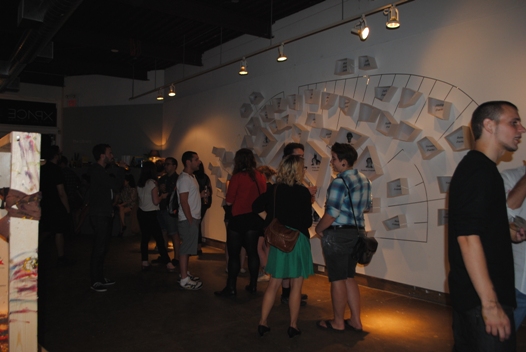
CORPUS LUCIDA - 12TH Annual Emerging Artist Exhibition at InterAccess

July 20th - August 18th, 2012

InterAccess Electronic Media Arts Centre
9 Ossington Avenue


Lanie Chalmers
Kyle Duffield
Omar Elkharadly
Aamna Muzaffar
Xhensila Zemblaku

Curated by Farah Yusuf

InterAccess’s 12th Annual Emerging Artist Exhibition, CORPUS LUCIDA showcases the work of 5 talented, emerging artists from in and around the Toronto area.  The show presents work that approaches the relationship between technology and the body through seeing rather than the more common approach of interactivity.  Corpus Lucida asks the viewer to turn inward and allow technology to affect their perception of the work. 

Optical illusions and the technology that creates them is an important aspect of this show.   Curator, Farah Yusuf describes that, “there is a sense of wonder that I get from science and technology meeting art; which I get from knowing how it’s made or what the work is commenting about.”  Omar Elkharadly’s work, Allegory (2009 - ongoing) whose title is a reference to Plato’s Allegory of the Cave, does this and more.  Harkening back to the early 19th century stereoscope, the work presents an optical illusion while revealing its source.  It is comprised of 2 slide projectors wired to a lampshade with a pull-chain that activates the projector to throw polarized light onto the lampshade which casts a stereoscopic shadow onto the wall behind.  Wearing the 3D glasses provided, the viewer is able to see a 3D image of the shadow of the lampshade.  Elkharadly describes the work and its inception stating that, “Initially, the work focused primarily on the mechanisms of perception by demonstrating what shouldn't be possible - a three dimensional shadow on a two dimensional surface.   What you see isn't what you get.  The mechanism by which this is achieved is almost poetically simple and is in no way concealed from the viewer.”       

 Credit: Omar Elkharadly, Allegory (2009, ongoing)

Another work that revisits early 19th century optical devices is Xhensila Zemblaku’s work, Daedalum (2012), based on the zoetrope which is a device that creates the illusion of motion through the use of static images.  Zemblaku’s work creates the illusion of a series of 3D heads endlessly doubling back upon themselves.  This mesmerizing work is the ultimate optical illusion.     

Xhensila Zemblaku, Daedalum (2012)

Kyle Duffield’s work, Chromastrobe (2012) surrounds the viewer and requires his or her body movements to activate the space.  Flashing bands of red, green, and blue, cycled at a rate of 60 frames per second are perceived by the viewer as a constant field of white.  That is until the viewer creates movement using their body; holding a hand in front of the face creates a pulsing sensation and residual trails of colour. 

 Lanie Chalmers plays with audience perception and notions of the gaze by changing the direction of the camera angle.  I Don’t Owe You Anything (2012), is comprised of 2 separate video shots of the artist’s face.  In the first view the camera is located above the artist, positioning the viewer as the dominant and in the second, the camera shot is from below, placing the viewer in a submissive position.   With regards to the gaze Lanie states that, “the gaze is intended here to destabilize the subject and object of the piece (that being the viewer and the work), what I mean by that is the object (my face) establishes a position of power and agency by way of being the looker, instead of just being looked at.  All of that said; my primary intention of this reversal is to position the viewer in an active role rather than that of the passive spectator.  The viewer has to actively negotiate their own position in relation to the confronting images. And both images incite complicated relationships depending on each specific viewer and how they relate to a woman staring at them from above or below.”  The gaze is further destabilized by the alternating images which switch sides every few minutes.

Aamna Muzzaffar’s rapid prototype sculptures, 24 Jogs are the ultimate combination between the physical body and technology.  Using a smartphone training device for running and a 3D rendering application Muzzaffar pushed herself physically and mentally to test her own spontaneous creativity.  The renderings created during the walking intervals of her runs were then printed in 3D and hand painted by the artist.  When asked about the importance of the relationship of the body to technology, curator Farah Yusuf stated, “It’s very important I think.  All of our media devices are kind of like prosthetics in a way; they all augment something that we might do naturally or that we can’t do at all.  They help us to overcome the physical restraints of our body.  They open up a new world to us and the body is always implicitly there.  In a way, technology is there to serve us.”  In the case of Muzzaffar’s work, technology serves physical goals and creative experimentation.

During her speech at the opening reception, Yusuf stated the importance of the aesthetic aspect of the new media works presented in this show.  “I knew that I wanted to make a show that was pretty accessible.  I find new media sometimes ghettoizes itself.  It discusses things that the average viewer or even the art viewer may or may not be as interested in.  I wanted an access point... When you start talking about affect and the visual, you return to the realm of the aesthetic and that aesthetic reaction to something is important to this show.”  The works chosen were immediately aesthetically pleasing and successfully drew viewers into the work.  Never have I experienced new media work that has been so accessible.  Farah Yusuf has succeeded in making new media works attractive and engaging all viewers.

This We Know...


Thursday, 2 August 2012

XPACE Summer Resident - Krystina Plante


Krystina Plante’s experience completing a 4 year art program at Central Technical School helped to give her a head start for her printmaking career at OCAD U.  She enjoys photography and sculpture, but printmaking is the one thing she “craves doing.”  I was fortunate enough to witness her passion for print while she completed her residency here at XPACE.


Jessica Cappuccitti:  What about printmaking do you love the most?

 Krystina Plante:  I think it’s a little bit of a couple of things – the fact that it is so technical, it’s a skill that you have to learn – there’re so many steps and there’s a lot of chemistry, you have to follow things like a recipe.  I like that it’s not just something you do on a whim; you really have to study and practice at it and then you become good and then it’s easy.  But I like that it challenges you.  There are so many things you can do in printmaking – you can combine it with so many other art forms, so it’s very versatile. 

 JC:  What method of printmaking do you use most often?

 KP:  My favourite printmaking mediums are lithography and intaglio and most recently I got into book-binding which was something new for me that I learned at OCAD.  My entire thesis was miniature books filled with prints.  There were over 400 prints in all these books and it was on hoarding and collecting.  Something else that I only learned recently that draws me to printmaking is the multiple.  The fact that you can have so many of one thing... I think as my practice continues that is something that is recurring in my work.  For example, in my thesis it was about excess and bulk.  Now with the project that I am working on here I am realizing that it is about multiples again.  A single thing takes on a whole new meaning when it is multiplied.

 JC:  Tell me more about the project that you are working on here at XPACE.

 KP:  I brought my blue print to show you (see photo).  I am mapping my genealogy – it’s like a family tree.  The reason I’m doing it is because a lot of my family has been adopted or displaced so most of them I haven’t met, or I know very little about them.  For example, I just found out that my grandfather has 4 siblings and I just found out his mother’s name... Because he fled Latvia because of the war when he was 9 and he hasn’t seen his family since so it’s not something he ever wants to talk about.  There’s so much I don’t know... my grandmother has 15 brothers and sisters who all live in England, most of whom I haven’t even seen photos of...  My mom, my uncle and my aunt were all adopted from different families... There’s just a lot of unknowns so that’s why I’ve wanted to tackle this for a while.


KP:  So the work is going to have lighting around the core.  That will be my immediate family unit which is small. This part which will be a combination of portraits and text for the names and is going to be backlit so it will be brighter. It will recede to darkness for the people that I don’t know. Because I am left in the dark with the rest of it...

JC:  How long has this been something that you have wanted to do?

KP:  I’ve wanted to touch on the subject matter for a while, but I only really thought of this idea after I got this residency which gave me the opportunity to make this big body of work that is funded and exhibited.  By the time I came to my orientation for the residency I had this idea in mind and got started on it.  I’ve been really strapped for time though because it’s been a lot of trouble-shooting.  For example, I started making all of the boxes in wood and had completed 14 of them before realizing that it wasn’t going to work because I was using 1 x 6’s which people usually buy for making fences and don’t care if the wood is warped.  I went through the entire bin and their new shipment - they were all warped, so unless I wanted to spend about 20.00 on one plank of pine (which I wouldn’t have been able to afford) I had to change my materials.

JC:  Did you construct each of the 14 wooden boxes yourself?

KP:  Yes, I made them at my dad’s house and used his tools... he hovered for a bit just to make sure I wasn’t going to break anything!  So the construction of those really set me back in my timeline.  I think I’ve tried to tackle something pretty big and budgeting time is always kind of hard.


 JC:  I think it’s almost poetic that the project you are working on is about family and here are your mom and dad, helping you put it together.  Does that make it mean more to you?

 KP:  I think it does because as much as it disappoints me that there’s so much about my family that I don’t know, I’m really lucky with the central core group that I have because we’re so close.  So I think it does reinforce that even more – having that help and knowing that these people are there for me.


 JC:  How do you see this residency affecting your future work?  Is this a project that you plan on building on? 

 KP:  I think that it might be a project that I will revisit down the road when I have unlimited time to maybe do some tweaks just to further it even more and maybe contacting those people that I don’t know and building those relationships and including that in the body of work.  But I think for now, this is a good opportunity for me to gain some exposure and interact with the people here at XPACE who are such an asset to me because they are trying to help out.  As opposed to a lot of other places that don’t see students as artists but as “artists in training,” which is really frustrating.  I think it’s great to have people that are supporting those of us that other people don’t want to.  It’s a really great opportunity to network and explore new things.

JC:  What are you going to take away from this residency?

 KP:  This residency has really acted as a learning curve for me. Learning how to think on my feet and how to quickly recover when something doesn't work as planned (it's been trial and error almost every step of the way for me so I've gotten better at troubleshooting), budget money, and more importantly budgetting time! One month is not a long time at all if you have ambitious plans and I know now more than ever that if you give yourself one day to do something it's going to take two!

 JC:  Any future plans or projects?

 K:  Yes, I do have a project that I am going to be starting soon.  It’s stemming from my thesis body of work which was, Life In Bulk.  At our thesis show and at the grad show I had a tall drawer unit where people could add to my collection by leaving whatever they wanted.  Some people would come back with something to leave; some people would just leave whatever they had in their pockets.  It is completely full now.  I am going to be working on a really long body of work which is a book and it’s going to be binding the narratives in all of those objects – my own narrative about who each of the objects came from and what purpose it served... So it’s going to be a long, ongoing body of work.


XPACE Summer Resident - Mason Mummery


Mason Mummery is a Sculpture / Installation grad from OCAD U whose sense of humour is reflected in his caricature-like sculptures and drawings.  I sat down with Mason and asked him a few questions while he worked on his art slingshot here at XPACE.


Jessica Cappuccitti:  When did you first become interested in sculpture? 

Mason Mummery:  In first year I took some mixed media and colour exploration classes which were pretty open to using things that were unconventional so I started using plasticine and sculpting with that, and just kind of fell in love with it – like the immediacy of it and the ease with which you can sculpt with it.  Plasticine has its drawbacks but it was a good starting point for me to learn what I like about sculpture and what I like about the medium.  I can be somewhat impatient with some things and I don’t like to wait for things to dry in molds so I usually use oven baked clays like Sculpey so I can sculpt it immediately and then it’s ready.  I usually tweak my projects in ways that will allow me to continuously work.  But I also do bronze sculpture and that’s a kind of slow process.  I do more realistic, figurative or traditional styles in bronze but I like the funny, light-hearted caricatures a lot. 

JC:  Tell me about the work you are doing here at XPACE during your residency. 

MM:  Originally the idea was to make a catapult that launched sculptures into the wall but it has evolved into a slingshot that launches it – there were a few technical problems with the catapult but the slingshot will do the trick.  I made some caricature figures out of rubber that will be launched at canvas that will be mounted on the wall.  This will allow people the opportunity to get their hands on the art and thus affect the final product of the work.  Whoever wants to play can mess around and leave their mark on it. 

JC:  Are the sculptures going to have paint on them? 

MM:  Yes, they’ll be dipped in paint – whatever colours people want to use, they can slather on and whip it at the wall.   

JC:  What are the sculptures made of? 

MM:  One is dragon’s skin – a casting rubber and the other is latex.  I was experimenting with the materials and the process.  I had never made a mold before so a lot of this has been trial and error.  There were a lot of road blocks but I learned a lot.  I had wanted the opportunity to try some things that I was less familiar or comfortable with so I tried to make this time a learning experience as well as a time to work on an art project that I have been thinking about for a while. 


JC:  What are you doing right now, as we speak?

MM:  Dissecting every sketchbook I have and taking out all of the pictures and collaging them onto here (the canvas that people will launch the sculptures at).  This is going to become a very temporal piece because it’s going to change every time someone else comes and every time somebody launches something, it will essentially erase a page or a drawing.  I’m a little sad...


JC:  Is this hard for you?

MM:  Yeah, it’s kind of strange.  I don’t know why I decided to do this either – I felt like it was a good idea.  I had to raise the stakes a bit too.  I like putting people on the spot, so maybe they’ll think twice about launching it.  I like that weird anxiety that might take place – I’m thinking that they may get excited about the idea of launching the sculpture at the canvas but then they’ll realize that they may have taken something away from the piece.  They are still adding but also removing or taking something away.  I think that is art, that’s what it’s really about – that people bring something to it and will affect it and change it in whatever way they choose.  I am curious to see how people respond to it and if they still feel compelled to launch at it given the opportunity.  So we’ll see whether excitement and spontaneity win over critical thought and artistic appreciation.


JC:  Has this residency made it easier to experiment with your work? 

MM:  I think the best thing about this is having the opportunity to showcase an artwork.  There’s something about having an art show and being given the space that helps to switch gears a bit to become more serious about it.  Anyone can do it on their own but once you actually have an end goal in mind or some sort of opportunity given to you with a time frame, you do your best to use it.  This has certainly pointed me in the right direction.   

JC:  Where do you see your practice going from here? 

MM:  It’s funny... the more humorous sculptures have always kind of run in tandem with my bronze sculptures.  I’ve sold a few of the bronze sculptures since school ended and I have been approached about commissions for a few larger scale works.  So as long as those things go well then I’ll have that going.  That will be like the hand that feeds my funny projects.  I think I’m more passionate about the funny stuff but I do also really like the opportunity for live studies that the bronze sculptures provide.   I think the funny stuff is where I see my practice steering.  It’s always taken a lot of heat – it didn’t feel like it was as accepted as the bronze work while I was going through school.  So now I can just embrace it and not have to worry about that.   

JC:  How do you see this residency influencing or affecting your future work?

MM:  I think the best thing I’ve learned from this is to not be inhibited in any way.  I think what will come next is hard to say right now but I’m sure it will be something along these lines.  My work is progressing one step at a time.  I think scale is something I’ll probably play with – going big!  And that’s another thing; I have a particular scale that I work in.  Most of my stuff is in the range of 6 inches to 12 or15 inches in height, just because storage and time are often issues.  Now that I’m done school, time is on my side so I can get projects going and not have to worry so much about deadlines.  I think that’s something I haven’t dealt with enough, is just being able to give it the time it needs.


Wednesday, 1 August 2012

Papermaking Workshop ~~~with Elija Montgomery

XPACE Cultural Centre
58 Ossington Avenue
Saturday, August 18th
1- 5pm


An Introduction to making paper!

Papermaking is simple and fun. This workshop will introduce you to the papermaking process- how you can make your own (recycled) paper using accessible and household equipment. be Great for all ages! (anyone under the age of 12 should be with a parent/guardian).

You will most likely get wet during this workshop, so dress appropriately, and feel free to bring an apron!

Please be aware that paper will need to be left to dry, so will be available to pick up during the following week, during regular gallery hours (tues-sat 12- 6pm).

Space is limited! Please RSVP to alicia@xpace.info

Tuesday, 31 July 2012

XPACE Summer Residency & The Beat and the Chorus at the Same Time - CLOSING RECEPTION


The XPACE Summer Residency came to an end this past Friday July 27th.  After a month of hard work our Residents got to show off what they created during their time here at XPACE. 


 Krystina Plante's deeply personal work, Missing Links regarding her broken family tree is beautiful and haunting.


 Lee Aaron Wiesblatt Let's Hope We Don't Have Another Solaris Situation on Our Hands Here turned XBASE into a technological cave of wonder.


 Mason Mummery's art slingshot had visitor's slinging paint-covered sculptures at canvases collaged in the artist's own drawings.


The Summer Resicency Show will be up until Saturday August 3rd. 


Hanna Hur's The Beat and the Chorus at the Same Time, in Window Space will be up until Saturday August 3rd.

Thursday, 26 July 2012

XPACE Summer Resident - Lee Aaron Wiesblatt

Recently I had the privilege to sit down with one of our XPACE Summer Residents to ask a few questions about his practice and the work he is doing here at XPACE.  Lee Aaron Wiesblatt, a recent graduate of OCADU's Printmaking program describes himself as a 27 year old emerging artist.  Previously at OCADU he studied Drawing and Painting, Sculpture and Installation as well as Criticism and Curatorial Practise before ending up in Print.  His multi-disciplinary background  influences his artistic practice, and from the sounds of it, will definitely be evident in the work he creates at XPACE.


JESSICA CAPPUCCITTI: When did you become interested in printmaking?

LEE AARON WIESBLATT: I've been into printmaking for quite some time. In high school I was experimenting on my own with stencilling and spray paint, and eventually the cheap Speedball home screen printing kits.  I had a couple of friends who were already in their upper years at OCAD and getting to watch them print encouraged me to start dabbling.  Even when I was taking more sort of cerebral academic courses I would always have some studio stuff on the side, so there was a sustained engagement with print all the way through; eventually I realised that's what I needed to do.  It was the last major I declared but it had been in my heart and in my course load all along.

JC: What type of printmaking are you most interested in?

LAW:  What I'm most interested in is photographic, mechanical reproduction, offset lithography, the four-colour process - I'm kind of a fetishist of that aesthetic - but my personal approach to print is almost always informed by experimentation, and trying to figure out what is appropriate to the statement that's being made.  So in general I'm kind of a big medium specificity guy and I try not to shoe horn any pre-existing idea into an existing aesthetic

JC: Tell me about the work you are doing here at XPACE for your residency.

LAW: What I think I am going to be doing is an interactive installation in XPACE, which will be sort of about mapping and reconfiguring a subjective space.  I don't know how much more I can tell you...  For this project I'm kind of going back to the drawing board and learning a bunch of skills that I've never built before including working with new media technology, specifically Arduino builds and programming.  This is all going to be pretty new to me but there should be a print component as well as a more traditional three dimensional installational component.

JC: How does being here in XPACE affect the way you work and provide inspiration?

LAW:  Well you've noticed that I have made myself at home.  I think there are some photographs of the workspace that I've brought to XPACE on the website. (see the home page and this blog post!)
I'm really into compartmentalization, so having a space that's specifically for working really helps to feel like I have something to do, a place to go mentally.  I'm just finding it an enormous asset and there's all kinds of tools, apparatuses and technology that's just around, and digging through it has been a big inspiration as well.  And of course Amber and Cameron and Alicia have been an enormous help in helping me clarify my idea and help crystallise it and I think that it's an enormous pleasure and an enormous honour to have been brought in. 

JC: Do you normally prefer to work in a collaborative environment, or do you prefer to work more independently?

LAW:  Well I think that I kind of think collaboratively before I've even opened my mouth, because I tend to attempt to view things through different angles... sort of analyse and break down connotations... think about how different people would come to the work, all toward the end of having a really succinct personal view point, regardless of whether it is immediately recognisable or anything that translates.  But I am very open to collaboration and I think that thought is formed like a language and language is communal in nature.

JC: Where do you see your practice going from here?

LAW:  That's a good question and I really don't have an answer at the ready.  I think I might take some time to just be a dude.  I'm currently working on a script for a short film that a friend of mine and I are going to be developing.  So that's always been an interest of mine as well, and I feel like this is the opportune time to try wearing as many hats as possible, and distribute myself creatively to figure out what comes next.  If there is a theme in my work, it's reinvention. 

JC: How do you see this residency influencing or affecting your future work?


LAW:  The work that I'm doing right now is taking me to places I haven't been before, and depending upon whether I have any measure of success with the really novel elements I'm bringing, that might be something that I explore for a while.  The idea of interactive work is deeply appealing to me.  I imagine that I'll be doing that a lot more in the future, and without this residency I doubt that I would have leapt into this kind of project so quickly after school.